top of page

We polled 100 homeowners: 64% thought under £500. Real average is £500-£800 without rods. See what drives cost from a Cardiff fitter.


On 5th Sept I put a simple poll on Nextdoor: “What would you expect a good quality stair runner to cost? 1 Flight of stairs fully fitted (excluding stair rods and landing).” 100 neighbours voted.


stair runner cost poll in cardiff on next door
Nextdoor poll - how much does a stair runner cost - 100 votes


This is exactly why I wanted to write this. People aren't trying to be unrealistic — they just picture a runner as a strip of carpet laid down the middle.
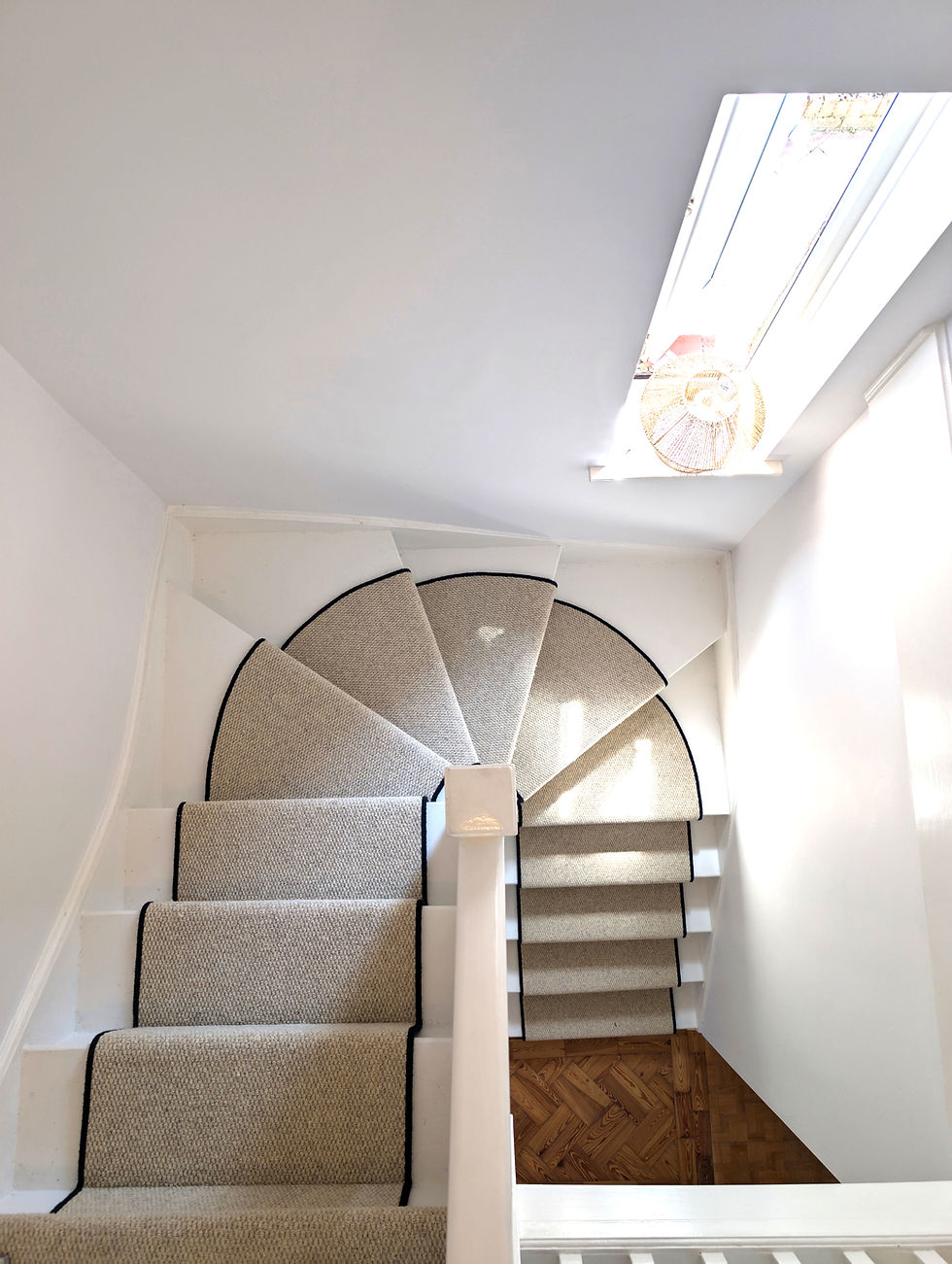

a bespoke stair runner with wool edge
A Bespoke Curved Winder

In real life, a good runner is a bespoke, made-to-measure job. Every staircase is different, and the ones that look the best in photos take the most work you never see.


Yes, A Runner CAN Be £300 — When It's A Remnant


We do say runners start from £300. That's when we have a remnant in stock — a good quality off-cut that happens to be exactly the right length and width for a straight 12-13 step flight. We whip the edges and fit it with proper underlay and gripper. No colour choice, no pattern matching, straight flight only.

That's the exception. The average runner we fit, without stair rods, sits between £500 and £800. Not because the carpet is expensive, but because of the labour that goes into making it fit properly.


The 7 Things That Take The Time (And What You Don't See Under The Bonnet)


  1. Templating The Winding Steps


precision templating of turning steps for a runner
Templating Turning Steps with Precision

Straight steps are the easy bit. Most houses in Cardiff, Penarth and Barry have quarter landings, half landings and winders — those pie-shaped steps that turn the corner. You cannot just measure a winder with a tape measure for a stair runner. Every single one is a different angle, different depth, different overhang.

We make a full-size paper template for every winder. Then we take those templates back to the workshop and lay them out with the carpet to cut and shape the runner. One set of 3 winders can take an hour just to template. Two sets of winders plus half landings can take 2-3 hours before we've cut a single piece of carpet, but this is the most important part — you will see from my installations that I like to give you, the customer, options. During templating I can show you how it would look with a curver or following the skirting boards. This is only possible the way I do it.


  1. How The Tape Is Hand Applied


Herringbone Stair Runner Striped Tape
A Herringbone Flatweave Stair Runner

Every metre is hand put into place, then stuck and stitched on with precision. The tape itself has to be joined, folded, mitred and blind stitched.

This is slow work. A 12-step flight needs over 6 metres of tape, both sides. That's 12-15 metres of hand finishing, and it becomes far more complex when it comes to winding stairs and landings.


  1. Joining The Tape On Turning Steps

Tape being joined using hot glue
Hot glue on taped joins to avoid fraying.

This is where a lot of runners fail. On a straight step, tape runs straight. On a winder, the tape has to turn a corner — sometimes 30 degrees, sometimes 45 degrees — and if it's striped or herringbone, the pattern has to line up.

We hot glue every join. You can't just fold it over or cut through it — each winder join is 15-20 minutes of careful cutting and gluing to eliminate the chance of fraying. A staircase with 6 winders is 2-3 hours just joining tape.


  1. Transitions


underlay and gripper in preparation for a stair runner
Getting the transition to landings correct! The next video is the result.

Getting the transitions to the landing and hallway correct is important. Ensuring the ends are tucked properly and have no chance of fraying takes time.

It's easy for these areas to look short, and many that I see online do, but I take time to ensure these transitions are done correctly and made to last.

If done incorrectly this is the first place that lifts and it's what people notice. If it's done well you don't notice at all, it just flows.


  1. Fitting The Stair Rods, Cut Individually, Not Off The Shelf


Stair rods look simple — a bar across the step. They are not. Every single rod is cut individually to the width of that specific runner.

A set of 12 rods is 12 separate cuts, 24 brackets, 48 screws, all centred by eye and level. That's 1-2 hours on its own, on top of the runner fitting.


  1. Preparation — The Bit Under The Bonnet No One Sees (Until I Show You)


Underlay and Gripper done correctly on turning stairs

You wouldn't buy a car without looking under the bonnet. Same with a stair runner. The runner is what you see, but what you walk on every day is what's underneath.

I show every customer the preparation and I post it on my social media — nothing to hide. Because this is where most runners go wrong and it's where we spend a lot of time getting it right. I'm proud of it.

For flatweaves like Gatsby, Lewis Abbott and Unnatural Flooring, you cannot use standard gripper and thick spongy underlay. Flatweaves are thin. If you use the wrong gripper, you see the pins through the weave and you feel every ridge. We use short-pinned gripper specifically for flatweaves, and we set it back perfectly so the pins don't show but still hold.

Underlay matters even more. We use a high-density, low-profile underlay — not cheap low density PU foam. It has to be dense enough to stop the runner moving, thin enough that the rods sit flat, and firm enough that winders don't collapse under your foot. On winders we cut the underlay to the exact shape of each template, not a rectangle. If you don't, the winder feels hollow and the runner wears out in months.

Getting gripper and underlay correct is an hour on a straight flight, two hours on a turning flight. It's dusty, it's on your knees, and it's not Instagrammable — but it's the difference between a runner that looks good on day one and one that still looks good in 5 years. That's why I photograph it for every job.


  1. Some Runners Take 2 Days To Fit — Here's Why


A straight 12-step flight in Gatsby with whipped edges — we can template, make and fit in a morning. That's why we can do fixed deals at £499-£649 for straight flights.

A full staircase with 2 flights, 2 sets of winders, a half landing, striped tape that has to be pattern-matched around turns, plus rods cut individually? Day 1 is templating and making in the workshop. Day 2 is fitting on site for 6-8 hours, because each step is fitted individually with underlay and gripper cut to the exact shape of the winder, not a rectangle thrown down.

That is the labour people don't see when they vote £100-£300 in a poll. They see carpet. We see two days of bespoke joinery in fabric.

The takeaway from 100 neighbours: 64% thought under £500 because they were pricing “a bit of carpet on the stairs”. Only 14% guessed £500-£800, which is actually where a good quality, fully templated, hand-taped, bespoke runner without rods sits. It's not that runners are overpriced — it's that a cheap runner is just carpet laid on stairs, and a good runner is a tailored product that has to fit a staircase that was never built square in the first place.


So What Should You Budget?


From £300: Remnant, straight flight, whipped edges, fitted with underlay/gripper — when we have stock that fits.


£399-£749 fixed: Straight 10-15 step flight, centre runner, no winders. Subject to measure, including fitting, underlay & gripper. Most straight stairs qualify.


£500-£800 average: Same as above but with 1-2 winders / quarter landing, or wool/sisal that needs extra shaping, without rods. This is our day-to-day and what only 14% guessed.


£800-£1,100+: Multiple winders, half landings, striped tape that has to be pattern-matched around turns, plus rods cut individually — full 2-day bespoke fits. This is craft, not carpet.

If you want to see where your stairs sit, use our instant estimator below. Every estimate is subject to measure.


and dont forget to follow me on instagram to see more installations


— Matthew, The Stair Runner Company, Cardiff.


Frequently Asked Questions


Can a stair runner really be £300?

Yes. From £300 is possible when we have a remnant in stock that happens to be the exact length and width for your straight 12-13 step flight. We whip the edges and fit it with proper underlay and short-pinned gripper. No colour choice, no pattern matching, straight flights only. It's the exception, not the average.

What is the average stair runner cost without rods?

£500-£800 fully fitted, without stair rods. This is what we fit most days in Cardiff, Penarth and Barry when there are 1-2 winders or a quarter landing. In our poll of 100 neighbours, only 14% guessed this correctly — 64% thought under £500.

Why do some stair runners take 2 days to fit?

A straight 12-step flight can be fitted in a morning — that's why we can do £499-£649 fixed deals for straight flights. A staircase with 2 flights, 2 sets of winders, a half landing, and striped tape that has to be pattern-matched around turns is a 2-day job. Day 1 is full-size paper templating of every winder and making in the workshop. Day 2 is 6-8 hours on site fitting underlay and gripper cut to the exact shape of each winder, not a rectangle.

What makes a stair runner expensive?

It's not the carpet — it's the labour you don't see. Templating winders (every winder is a different angle), hand-applying 12-15 metres of tape, hot-gluing every join to stop fraying, cutting underlay to shape, and cutting every stair rod individually to that step (12 rods = 12 cuts, 24 brackets, 48 screws). We show all this prep on our socials — nothing to hide.

Does the price include underlay, gripper and fitting?

Yes. All our prices include high-density low-profile underlay, short-pinned gripper for flatweaves, and full fitting. For flatweaves like Gatsby, Lewis Abbott and Unnatural Flooring we don't use cheap foam or standard gripper — you'd see the pins through the weave.

How do I get an accurate price for my stairs?

Use the instant estimator on our site and send photos on WhatsApp. Every estimate is subject to measure


For too long, we've treated our staircases and landings as a single, uniform entity when it comes to carpeting. But what if I told you there's a growing trend that not only enhances the durability and comfort of your home but also unlocks exciting new design possibilities? It's time to embrace the art of separating your stairway and landing carpets.


The Logic: Durability Meets Luxury


Let’s take a moment to think about your stairs! They face a daily onslaught of concentrated footsteps. If you choose the wrong carpet, you might see those steps leave their mark in the form of flattening just weeks after installation! Your staircase often connects to hard floors in the hallway, making it the first place to catch dust from shoes, socks, or slippers. This mix can cause the wrong carpet to lose its plush look and feel in no time.


Now, let’s talk about landings! These areas experience less foot traffic and lead to cozy bedrooms where comfort is key. So, why should we treat these two different spaces the same when it comes to carpet selection? The answer is simple: they probably shouldn’t!


Harder-Wearing for the Steps


The key to a long-lasting and practical stair carpet lies in its durability. Opting for a more robust, tightly woven, or lower-pile carpet specifically designed for high-traffic areas on your steps will significantly extend its lifespan. This means less worry about wear patterns, flattened piles, and the need for premature replacement.


Softer, Luxurious Landings


Once you've ascended the stairs, you want to step onto a landing that feels like an extension of your cozy bedrooms. This is where you can indulge in a softer, more luxurious carpet with a deeper pile. Imagine the feeling of plush comfort underfoot as you transition from the busy thoroughfare of the stairs to the tranquility of your private spaces.


The Aesthetic: A Balance of Colours


Now, let’s talk about the exciting part: design. Using different carpets might make you think of sudden changes, but actually, it opens up limitless style choices. This approach works great with many colour tones. Here are some ideas to think about:


Complementary Hues


Choose a slightly darker or more patterned carpet for your stairs that complements a lighter, solid-colored carpet on your landings. For example, a charcoal grey stair carpet could lead to a pale grey or even a muted blush pink landing carpet, creating a subtle yet impactful visual flow.


Texture Play


Even within the same colour family, varying textures can create interest. A ribbed, herringbone, or subtle striped carpet on the stairs could lead to a velvety smooth landing carpet in a similar shade.


The Feature Staircase


With this approach, your stairs truly become a feature. A bold pattern or a rich, deep colour on the stairs can make a dramatic statement, while the landing carpet can recede, allowing the stairway to shine. After all, the landing carpets are often "out of the way and out of sight" from the main living areas, making them the perfect place for a more understated choice.


Embracing the Runner Trend (and Its Limitations)


The rise of stair runners has undoubtedly paved the way for more creative stair coverings. They highlight the individual treads and risers, adding character and often intricate patterns. However, carpets that work exceptionally well for runners (think bright bold stripes or monochrome herringbone) don't always translate seamlessly to a landing. Trying to force a runner-style carpet onto a landing can sometimes feel overwhelming or have its limitations within your budget.


By separating the two, you can have the best of both worlds: a striking, durable runner-style carpet on your stairs that perfectly complements a more subdued and comfortable cost-effective carpet on your landing that can also run through into your bedrooms.


Putting You at Ease: The Seamless Transition


You might be wondering about the transition between the two carpets. Rest assured, this is where professional installation comes in. As an experienced stair runner fitter, I'm adept at creating neat transitions between different carpet types. You can see some examples of these in the images below. Visit my Instagram page for more examples here (please follow whilst you are there!)

The most common transition sees the landing carpet tucked over the top step and finished under the nosing. This is more successful if any beading trims that may already be in place are removed. In this circumstance, the runner will go up the top riser and meet your landing carpet under the nosing of the landing.


Another option is to finish the landing carpet on the top of the step with a threshold, leaving the nosing of the landing exposed and painted or varnished in tune with the rest of the decor. Again, the runner will finish under the nose of the landing so when you look up the stairs, the landing carpet is not visible at all (see below).


But don't panic; all of this can be discussed and finalized during a home consultation with me.


Underlay


I often use different types for stairs (firmer for stability and durability) than for landings (softer for comfort). This difference in feel underfoot is not a flaw but a deliberate choice that enhances the performance and comfort of each area.


It's Time to Rethink


So, as you plan your next home refresh, take a moment to re-evaluate your approach to stairway and landing carpets. By separating them, you're not just making a practical choice for durability and comfort; you're opening the door to a more sophisticated, personalized, and truly stylish home. Your stairs are a journey, and with this new approach, every step of the way can be a delight.


If you live in Cardiff or the Vale of Glamorgan, you can book your home consultation with me today by visiting my website www.thestairrunner.co.uk.


Choosing the ideal carpet for your home can be overwhelming, so which carpet fibeR is best for you? With so many options available, how do you ensure you make the right choice? Carpets significantly affect the comfort and look of your living spaces, so it's crucial to select wisely. After years of visiting customers' homes, observing their decor and carpet selections, and seeing how these carpets hold up, I'm here to offer my insights. This guide is designed to help you make an informed decision, whether it's for your stair runner, living room, or bedroom, you will often be torn between wool and polypropylene.

Understanding Wool Carpets


Wool carpets have stood the test of time, and they bring a touch of luxury to any home. The natural fibers offer many benefits that enhance your living environment, and putting my cards on the table, I am a big fan of wool mix carpets, its on my stairs and after 5 years its almost as good as the day it went down.


Wool is a renewable resource, sustainable, and biodegradable, making it an eco-friendly choice, this alone is a feature that appeals to many. In addition, its natural stain resistance and excellent insulation create a cosy atmosphere all year-round. Research also shows that wool carpets can reduce heating costs by up to 10% due to their insulating properties.


One standout feature of wool carpets is their durability. They can withstand significant foot traffic, helping them maintain their appearance longer than many synthetic alternatives. I feel the biggest factor in this is the wool's inherent ability to bounce back or "bouncebackability" (as a Premier League manager once said).

A good-quality wool carpet can last 20 years or more with proper care.


a selection of wool carpet samples from Manx Tomkinson (uk)
a variety of wool carpets available from manx tomkinson (uk)

While wool carpets may be pricey, investing in them for areas such as living rooms, stairs & landings or bedrooms may be worth it for their elegance comfort and durability. These carpets not only contribute to a warm aesthetic but also improve indoor air quality, making your home healthier.


Exploring Polypropylene Carpets


On the other end, polypropylene carpets offer an affordable alternative that many homeowners appreciate. Made from synthetic fibers, these carpets are known for their durability and easy maintenance.


The most significant advantage of polypropylene is its remarkable stain resistance. I’ve witnessed firsthand how spills can easily be wiped away without any lingering marks, which is a significant plus for families with children and pets. More than 90% of polypropylene carpets are resistant to common household stains, making them incredibly practical.


Polypropylene carpets come in a diverse array of colors and patterns. This allows you to add a personal touch to your decor. In my experience, choosing a vibrant design for a child’s room created a fun and lively atmosphere.


Another benefit I found is their quick-drying nature. In areas with high humidity, polypropylene carpets remain fresh and clean, making them suitable for spaces like basements and entryways.


Close-up view of a vibrant polypropylene carpet in a playful children's room
a 100% polypropylene berber from abington flooring, great for stair runners and busy houses.

However, while polypropylene is budget-friendly, it's essential to note that it may lack the luxurious appeal of wool carpets. From my observations, some polypropylene choices can appear less refined and might not endure heavy foot traffic as well over the years.


Comparing Comfort and Feel


When deciding between wool and polypropylene, comfort and feel are essential factors. Wool carpets offer a plush, welcoming feel underfoot, imparting warmth in chilly months. The natural fibers breathe well, which helps in reducing allergens, making them more comfortable for allergy sufferers.


Polypropylene, while sufficiently soft, doesn't always match the sumptuous feel of wool. Despite this, it can still provide ample comfort for informal areas like playrooms or nooks. It prioritizes durability and easy cleaning, two significant aspects for busy families.


The comfort level can also depend on the specific pile and construction of the carpet. I’ve experienced some much softer polypropylene options recently, that surprisingly rivaled wool in terms of comfort.


Maintenance care and performance


Caring for wool carpets is crucial, as they require more upkeep than their synthetic counterparts. Wool is more sensitive to moisture and may need professional cleaning occasionally (never attempt this yourself), particularly in the case of stubborn stains. If spills happen, rapid cleanup is essential, often just soaking up stains with kitchen roll until the area is dry.


As with all carpets, regular vacuuming with the correct type of vacuum is essential to the carpet's longevity. I explain which vacuums are best for all carpets purchased during the quotation process.


Polypropylene fibres do not bounce back like wool, so regular vacuuming is essential. You have to really ensure you disturb the pile and remove dust to keep it looking good. Most stains can be handled effectively with a good carpet cleaner like Dr. Beckmann's. Whenever you see before and after pictures by carpet cleaners, they will always be with polypropylene carpets. What you often don't see is how further down the line the carpets have stretched due to the latex breaking down from excess cleaning. This is a really big issue with all carpets, especially when customers purchase their own machines and do not remove the water sufficiently.


High angle view of a cozy staircase with a patterned stair runner
an 80/20 wool mix from manx tomkinson

Budget and Longevity


Let’s discuss finances. If you’re watching your budget, polypropylene often shines as more affordable option, however there is definitely a crossover, the trade off may be a shorter depth of pile with wool but that can be countered with a better underlay still giving you the bounce under foot.


As with most things, it’s essential to weigh the long-term costs. While polypropylene may save you money upfront, wool carpets usually offer more value over time, especially when opting for high-quality products. With the fitting costs involved, changing carpets every 3-4 years can become an expensive exercise, albeit one which some people enjoy just for the change of decor. Wool carpets can last significantly longer, often outlasting multiple polypropylene carpets, especially in high-traffic areas.


Which carpet fibre is best for you?


Choosing between wool and polypropylene comes down to personal preferences, lifestyle needs, and budget constraints. If you're after luxury and longevity, wool carpets are the best choice.


Alternatively, if you need a cost-effective solution for busy areas, polypropylene carpets can still deliver style and functionality.


The response to the question "Which carpet fiber is best for you?" likely involves a blend of both throughout your home. However, if you can, always invest in wool for your hallway and stairs. In the flooring industry, an 80% wool and 20% polypropylene (or any synthetic blend) is considered highly durable.


Final Thoughts


When it comes to selecting flooring, the decision between wool and polypropylene carpets ultimately reflects your specific needs and preferences. My journey has made it clear that both types have distinct advantages and challenges.


Whether you lean towards the classic appeal of wool or the practical perks of polypropylene, the right carpet awaits you. Take time to assess your lifestyle, explore your options, and make a choice that fits seamlessly into your home. Hopefully, this has helped you decide which carpet fibre is best for you. Happy decorating!


The Stair Runner Company Ltd. 

​

Bespoke Wool, Flatweave, Sisal and Synthetic Stair Runners. Custom Edging and Borders. Cardiff and The Vale of Glamorgan.  We also fit flooring to all your other rooms! 

© Copyright

2026 The Stair Runner Company Ltd. All Rights Reserved

Areas Covered:-

​

  • Cardiff & Surrounding Districts

​

  • Penarth & The Vale of Glamorgan

​

  • Barry, Dinas Powys, Wenvoe & St Athan


Payments Accepted

The Stair Runner Company Standard

​

  • Bespoke Tailored Solutions 

​

  • 25 Years Experience

​

  • Premium Quality Materials

​

  • Fully Insured Local Business

​

  • Honest Educated Advice

​

  • Trusted by Customers


bottom of page